Wellness
Why Your Nervous System Is Ageing Your Skin

In this article
Most people think of skin ageing as something that happens to the face. Lines appear, volume shifts, pigmentation arrives. What is less widely understood is that a significant portion of what we call ageing is not happening to the face at all — it is happening to the nervous system, and the face is simply where we see the result.
At REGEN Clinic, we work with clients who eat well, sleep reasonably, and invest seriously in their skincare. Some of them still age faster than their habits would predict. More often than not, chronic stress is the variable that explains the gap.
What Stress Actually Does to Skin
When the body perceives stress — whether that is a difficult week at work, a difficult decade of overcommitment, or simply a nervous system that never fully comes down — it releases cortisol. Cortisol is the body's primary stress hormone, and it is useful in short bursts. It focuses the mind, sharpens reactions, and prepares the body for effort.
The problem is that modern stress is rarely short. It is persistent, low-grade, and cumulative. A nervous system under sustained load keeps cortisol elevated, and elevated cortisol has well-documented consequences for skin health.
It breaks down collagen. Cortisol activates enzymes called matrix metalloproteinases that degrade the collagen fibres responsible for skin firmness and structure. This is not a slow, theoretical process — it is one of the clearest biochemical mechanisms linking chronic stress to accelerated skin ageing.
It compromises the barrier. Cortisol disrupts the production of ceramides, fatty acids, and other lipids that form the skin's protective outer layer. A weakened barrier loses water more readily, becomes more reactive to products and environment, and is slower to recover from irritation or treatment.
It amplifies inflammation. Stress triggers low-grade systemic inflammation. For skin, this manifests as redness, sensitivity, flare-ups of existing conditions like rosacea or eczema, and slower post-treatment healing. Clients who struggle to tolerate corrective treatments often have an underlying inflammatory burden that explains their sensitivity.
It disrupts sleep quality. Chronic stress fragments sleep, and the skin does much of its repair work during deep sleep phases. A nervous system that cannot settle fully at night is a skin that cannot repair itself fully either.
Why This Matters Clinically
At REGEN Clinic, we assess skin before we treat it. Part of what that assessment involves is understanding the full picture — including the lifestyle context that may be driving or slowing results. A client who is chronically stressed will have a different skin biology than a client who is not, and treating them identically will produce different outcomes.
This is not a reason to delay treatment. It is a reason to integrate nervous-system support into the wider skin health plan, not as a wellness afterthought, but as a clinically coherent strategy.
The Role of the Nervous System in Long-Term Skin Results
The skin and the nervous system are developmentally connected. Both originate from the same embryonic tissue — the ectoderm. This shared origin means they remain in communication throughout life via neuropeptides and inflammatory signalling molecules. When the nervous system is dysregulated, that signal reaches the skin.
This also means the reverse is true. Interventions that calm the nervous system — deep tissue massage, scalp treatment, breathwork, genuinely restful sleep — reduce the inflammatory burden on the skin. They are not luxury indulgences. They are physiologically meaningful inputs into the same system that determines how your skin responds to treatment and how well it holds its results.
What REGEN Does Differently
Within the REGEN Method, the Nurture pillar exists precisely to address this. Long-term skin health is not achieved by one treatment and a good skincare routine. It is built through sustained, low-stress skin management — regular reviews, adjusted plans, and the kind of consistent, calm oversight that prevents the peaks and troughs that often characterise more reactive approaches to skincare.
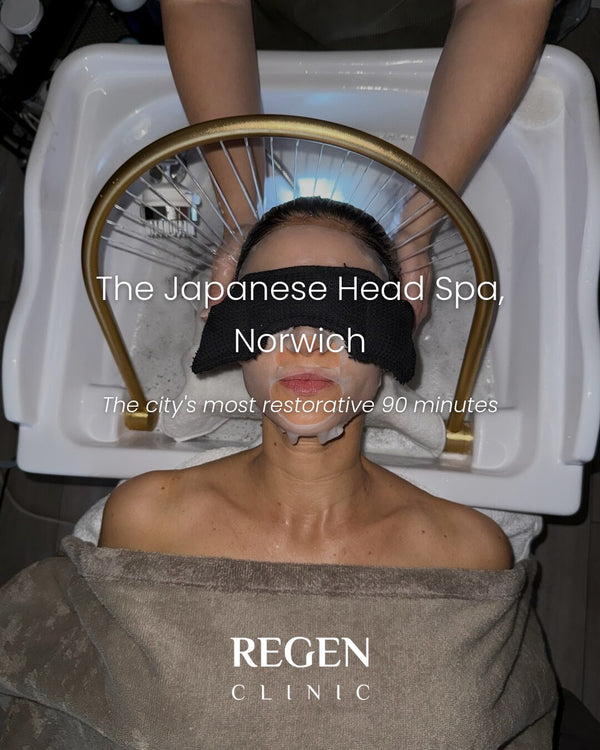
Our Japanese Head Spa treatments, offered at our Norwich clinic, are positioned inside this pillar deliberately. A scalp treatment that reduces cortisol, improves circulation, and supports parasympathetic nervous system activity is not a spa indulgence — it is a physiologically sound addition to a skin health plan for clients whose nervous systems need support.
Equally, our massage services — from deep tissue to Swedish — serve a clinical function. They reduce circulating cortisol, improve lymphatic clearance, and support the quality of sleep that makes every other skin intervention more effective.
A Practical Note
If you are investing in skincare and in-clinic treatment but not addressing chronic stress, you are working against yourself. Not dramatically, but measurably. The skin reflects the whole person — and the most comprehensive treatment plan we can build takes that into account.
If you would like to discuss how stress may be affecting your skin, and how we can structure a plan that addresses the whole picture, we would be glad to help.
Book a Reveal Consultation at theregenclinic.com to begin.
Read further, or actually do something about it.
If anything in this piece sounds like your skin, the next step is a Reveal Consultation. A 60-minute doctor-led skin assessment, a documented plan, and where appropriate the first treatment in the same visit.