Wellness
Why Your Skincare Routine Stops Working When You're Stressed — The Cortisol-Skin Connection
I see this every week — clients who have done everything right with their skincare but whose skin still won't behave. The variable they haven't accounted for is almost always stress. Here is what cortisol does...

In this article
I see a version of the same conversation in clinic almost every week. A client has an excellent regime. Medical-grade homecare, regular treatments, the right SPF, the right diet. They have been doing everything right for months. The skin is still not behaving. They are baffled, and slightly hurt — they did the work, where is the result?
The variable they haven't accounted for is almost always the same one: stress. Specifically, what chronic, low-grade, modern-life cortisol is doing to the skin underneath their best efforts.
This is one of the more under-discussed mechanisms in the aesthetic conversation, and the one that — when it's addressed — most often unlocks a result that has been stuck. So here is the short clinical version of what I tell clients about stress and skin, and what to do about it.
What cortisol actually does to skin
Cortisol is the body's primary stress hormone. In short bursts it is useful. In persistently elevated form, which is the modern default, it does five things to skin that I see in clinic regularly:
It thins the dermis. Cortisol suppresses collagen synthesis. Long-term elevation produces measurably thinner, more fragile skin — visible on close assessment, harder to bounce back, less responsive to regenerative treatment.
It impairs the barrier. Stress-elevated cortisol reduces ceramide production and increases trans-epidermal water loss, which is why so many high-performing professionals describe skin that has suddenly become reactive. It is not sudden — it is the cumulative effect.
It drives inflammation. Cortisol modulates immune function. Persistent elevation pushes the skin toward a low-grade inflammatory state that shows up as flares of acne, rosacea, eczema, scalp irritation and post-inflammatory pigmentation.
It disrupts the wound-healing cycle. Skin that is being asked to recover from any insult — a peel, a procedure, a breakout, sun damage — heals more slowly when cortisol is high. The result that should have arrived in six weeks arrives in twelve.
It interferes with sleep, which compounds everything. Most skin repair happens in deep sleep. Stress disrupts sleep. Disrupted sleep means less repair. It is a closed loop.
The visible result: dullness, fragility, breakouts, slower response to treatment, and a baseline that is harder to budge regardless of what you put on it.
Why your routine stops working
A skincare routine works by giving the skin tools — actives, peptides, regenerative signals, barrier support, sun protection. Those tools are inputs. The skin is the system that has to use them.
If the system is in a chronically inflamed, sleep-deprived, cortisol-elevated state, it cannot make use of those inputs efficiently. You can pour good ingredients into a damaged system and you will get a fraction of the result. That is what most stressed clients are experiencing — not that the products are bad, but that the system is not in a state to deploy them.
This is also why the same product can produce a beautiful result for a client in one season of their life and almost nothing in another. The product hasn't changed. The internal terrain has.
What I actually recommend
The intervention here is not a stronger active. The intervention is to get the system into a state where it can use what it has. In clinic, the most reliable lever I have is structured wellness — interventions that lower the cortisol curve, restore parasympathetic tone, and improve sleep quality. That is not soft advice. It is a direct enabler of the work everyone else in the routine is doing.
Three things I recommend most often:
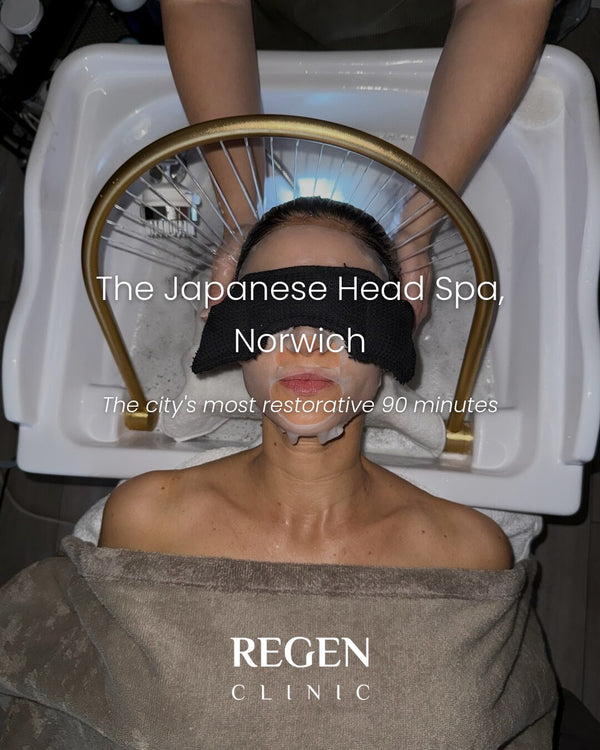
Regular structured massage that engages the parasympathetic nervous system — meaning sustained, moderate-pressure, scheduled. This is exactly what the Japanese Head Spa protocol is built around. Twenty to forty minutes of structured scalp work has measurable cortisol-lowering effects, and clients who come monthly report the most durable downshift in their baseline reactivity.
Sleep hygiene that is treated as non-negotiable. There is no skincare regime that compensates for chronic short sleep. The most powerful active in the world is whatever happens in the four hours of slow-wave sleep your body would have had if you had got into bed an hour earlier.
A skincare regime that supports the barrier rather than fighting it. When the system is stressed, lighter is better. We will often pull a client back from a stack of aggressive actives towards a calmer regime for six to eight weeks while wellness work catches up. The result is almost always better skin, faster.
The bigger point
The best skincare regime in the world cannot outperform a stressed system. A regime that is paired with serious wellness work — particularly sleep and structured massage — almost always outperforms a regime that is not.
If your routine is good but your skin is stuck, the issue is rarely the routine. The conversation worth having is in clinic. Start with a Reveal Consultation and we'll work out what the system actually needs — including, often, what to take out of your routine, not what to add to it.
Read further, or actually do something about it.
If anything in this piece sounds like your skin, the next step is a Reveal Consultation. A 60-minute doctor-led skin assessment, a documented plan, and where appropriate the first treatment in the same visit.