Wellness
Does Scalp Massage Actually Stimulate Hair Growth? What the Evidence Says
Clients ask me whether scalp massage really does anything for hair growth, or whether it just feels nice. The honest answer is: the evidence is small but consistent, and the mechanism is plausible. Here is what...

In this article
A few times a week, a client asks me — usually mid-treatment, mid-conversation — whether scalp massage actually does anything for the hair, or whether it just feels good. They expect me to say the latter.
The honest answer is more interesting. Scalp massage is one of the few wellness interventions where the mechanism is biologically plausible, the evidence is small but consistent, and the downside is essentially nil. It is not a magic bullet for hair loss. But it is a credible adjunct, and the way we deliver it in clinic is a long way from the head rub at a hairdressers.
What the research actually shows
The most-cited piece of evidence is a small but well-designed study by Koyama and colleagues, published in Eplasty in 2016. Nine men performed four minutes of standardised scalp massage daily for 24 weeks. Hair thickness measurably increased by the end of the trial, with the proposed mechanism being mechanical stretching of dermal papilla cells, which appears to upregulate genes associated with hair growth.
A larger 2019 survey of around 327 participants reported by English and Barazesh in Dermatologic Therapy found that, in the subset who performed twice-daily scalp massage for at least six months, the majority self-reported reduction in hair loss and improvement in density. This is observational data — useful as a real-world signal, less robust than a randomised trial.
The supporting mechanism evidence is also reasonable. Manual stimulation increases local blood flow, may modulate the local stress response in the scalp, and demonstrably reduces salivary cortisol when applied with moderate pressure for 20 minutes or more (a finding established by Field and colleagues across decades of touch-research literature).
In short: the evidence for scalp massage as a small, additive support for hair quality is real. It is not a replacement for treatments where there is a stronger evidence base — minoxidil, finasteride, PRP for hair, polynucleotides for hair — but it can credibly sit alongside any of them.
What this looks like in clinic
In practice, the version of scalp massage that actually moves the needle is structured. It is performed at moderate pressure, in defined movements, for a meaningful duration — not a token thirty seconds before a shampoo. It is consistent — daily or twice-daily for short bouts, or weekly to fortnightly for longer professional sessions.
Tools matter less than people assume. A pair of trained hands, applying the right pressure across the right pattern of the scalp, outperforms a gimmick gadget every time. There is a place for high-frequency, microcurrent and red-light devices — but they are adjuncts to manual work, not replacements for it.
Where the [Japanese Head Spa](/pages/japanese-head-spa) fits
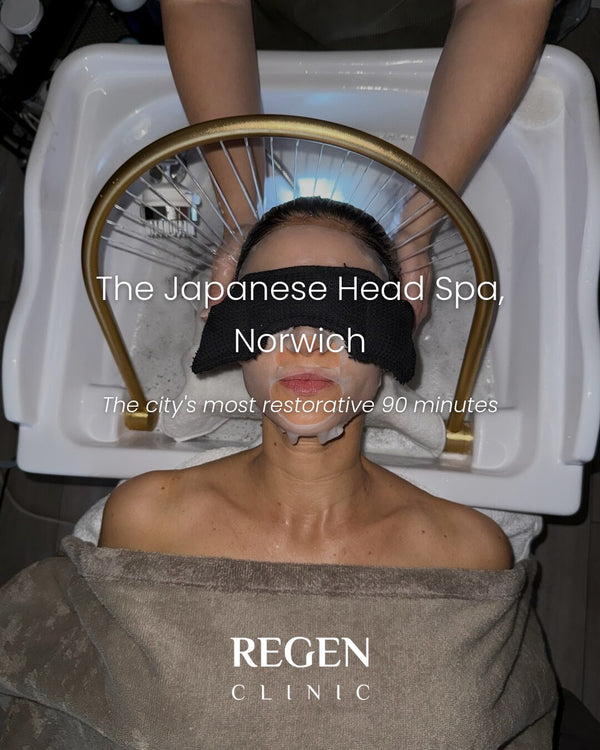
The Japanese Head Spa we run in our Norwich clinic is the most structured way I know to deliver this kind of work consistently. The format isn't a luxury indulgence dressed up as wellness — it is a clinically considered ritual. A typical session sequences scalp cleansing and exfoliation, sustained scalp and head massage at appropriate pressure, the water halo, oil treatment, and (depending on the length of session) facial cleanse, neck-and-shoulder release and a final mask.
That sequence does three things that matter for hair and scalp health:
It removes accumulated sebum, product residue and dead cells from the follicular environment. A clean follicle is a follicle that can grow hair. A blocked one cannot.
It delivers manual scalp stimulation at the duration and pressure that the literature suggests is meaningful — 20 to 40 minutes of structured contact rather than the few seconds you would give yourself in the shower.
It engages the parasympathetic nervous system. Lower cortisol, improved sleep that night, and a more recovered baseline are not soft outcomes — they are physiological outcomes that affect every system that touches hair, including immune-mediated shedding.
For clients with thinning, post-pregnancy shedding, perimenopausal changes, or long-standing scalp irritation, I most often recommend integrating this into a broader plan rather than running it as a standalone. Monthly or fortnightly Head Spa, paired with a topical or in-clinic regenerative protocol such as PRP, is the version that produces the most consistent visible improvement.
The honest take
Scalp massage is a small, credible, well-tolerated intervention with a plausible mechanism and modest but real evidence behind it. It is not a hair-loss cure. It is, for the right client, a worthwhile habit — and when delivered as a structured ritual rather than a token gesture, it earns its place.
If you are dealing with hair shedding, scalp irritation, or are simply running too hot for too long and want to do something that actually helps, the conversation worth having is in clinic. Start with a Reveal Consultation, or ask about pairing the Japanese Head Spa with a regenerative hair protocol — that combination is where I see the most consistent results.
Read further, or actually do something about it.
If anything in this piece sounds like your skin, the next step is a Reveal Consultation. A 60-minute doctor-led skin assessment, a documented plan, and where appropriate the first treatment in the same visit.