Skincare
Men's skincare: a straightforward starting point

In this article
Most men open the consultation with an apology. Some version of "I don't really do any of this", said before they have sat down properly. The apology is unnecessary, and it tells me something useful: they have arrived without the assumptions that usually have to be unpicked first.
What follows is one of the more efficient consultations I do. There is no accumulated routine to dismantle, no half-finished course of something bought online, and very little interest in skincare as a hobby. The question is almost always the same, put plainly. What is worth doing, and what can I ignore.
Male skin is genuinely different, and it matters less than you would think
Male skin is measurably thicker on average, with higher collagen density and higher sebum production driven by androgens. Collagen then declines steadily with age rather than dropping away sharply, which is why men tend not to notice a single year in which their face changed.
The practical consequences are modest but real. Oilier skin means congestion and enlarged-looking pores are more common, and they persist later into adult life. Thicker skin tolerates active ingredients better, so a routine can be built up faster. Deeper expression lines across the forehead and between the brows are more common, partly because men are less likely to have protected the skin from ultraviolet exposure for thirty years.
That last point does most of the work. The differences that show up in my consultation room are less about biology than behaviour: sun exposure without protection, and a much later first appointment. Men present with more established change simply because they present later.
Shaving is already a routine, whether you think of it as one or not
If you shave, you are exfoliating your face several times a week with a blade. That is not a criticism — it keeps the surface turning over, which is an advantage. But it changes what your skin will tolerate, and it is the single most useful thing you can tell me in a consultation.
It means the barrier is under regular mechanical stress, so anything strong introduced on top of it needs sequencing rather than enthusiasm. It also means irritation, ingrown hairs and the small inflamed papules along the jaw and neck are usually a shaving problem before they are a skincare problem. Coarse or curly hair makes this considerably more likely, and no serum resolves it if the blade and the technique stay the same.
So the first conversation is often about how you shave, not what you put on afterwards. Changing the order of two things you already do is cheaper than adding a third.
What men actually come in for
Three concerns account for most of it.
The first is looking tired. Not lines specifically, but the shadowing around the eyes and the sense of looking less well than you feel. That is worth assessing rather than treating on assumption, because the same appearance can come from volume change, pigment, texture, or skin that has simply become dull. The answer is different in each case.
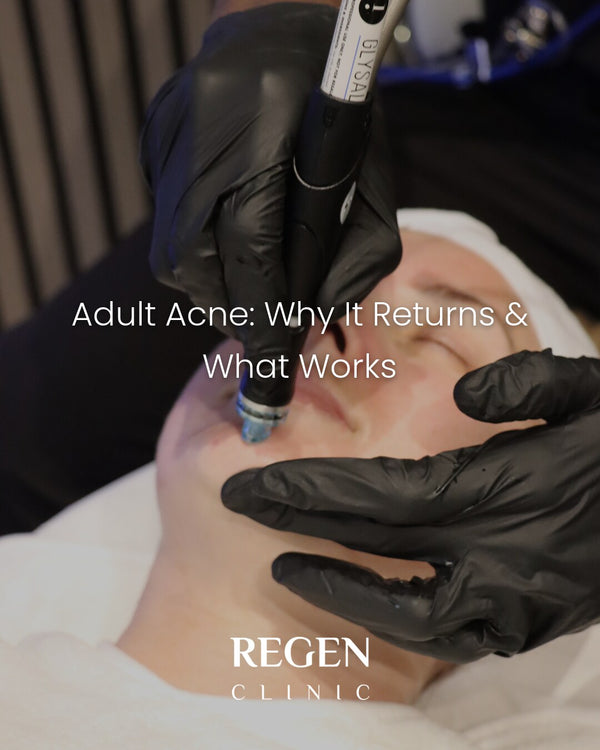
The second is texture and congestion, where oilier skin shows itself, along with the marks left by acne years earlier. Resurfacing work such as advanced microneedling is often relevant, alongside a properly prescribed homecare routine. If you want something with no recovery attached first, a HydraFacial is an undramatic place to begin.
The third is hair. Thinning at the temples or crown is raised most reluctantly and left longest, which is unfortunate, because it is where timing matters most. Hair loss responds better to early assessment than late intervention, and the first step is establishing what type of loss it is rather than reaching for a treatment. Our hair and scalp pathway starts with assessment for that reason, and PRP hair therapy is considered only once suitability is clear. Individual results vary, and nobody should be promising you otherwise.
Anti-wrinkle treatment comes up too, usually framed as a worry about looking obvious. It is a prescription-only medicine, so suitability is decided at consultation, and the aim in men is almost always softening rather than removal. How we approach it is set out on the anti-wrinkle injections page.
The thing I check that nobody asks me to
When I assess a man's face properly, I am also looking at sun damage, and at anything on the skin that does not belong there.
Men in the UK are more likely to die from melanoma than women, largely because it is found later. I am not a mole clinic and I do not offer skin cancer screening. But I look, and if something concerns me I will say so and direct you to have it examined properly.
It is not the reason anyone books, and it is one of the more useful things that happens in the room.
How this fits the REGEN Method
This is the Reveal stage of how we work, and for men it is doing more of the heavy lifting than usual.
Reveal is a proper assessment before anything is recommended: what the skin is doing, what is causing it, and what is worth treating. For someone arriving without a routine or strong preconceptions, that often produces a shorter answer than expected. Sometimes the plan is homecare only. Sometimes the honest answer is that the shaving needs sorting first and nothing else is required yet. Only then do we discuss whether in-clinic treatment is appropriate, and in what order.
If you would rather start with something lower commitment, our skincare quiz will give you a sensible starting routine without a consultation. It is a reasonable first step. It is not an assessment.
Frequently asked questions
Do men need different skincare products from women?
Not fundamentally. The ingredients that work are the same. What differs is the starting point: oilier skin, daily shaving, thicker skin that tolerates actives sooner, and a face that has had less sun protection over the years.
I shave every day. Does that rule out treatments?
No, but it changes the sequencing and the aftercare. Tell us at the consultation, because it affects when you can shave around a treatment and how quickly a routine can be built up.
What is the minimum worth doing?
A cleanser suited to your skin, one active ingredient chosen for your main concern, and daily sun protection. Three steps, used consistently, outperform an elaborate routine used sporadically.
Can I just book one treatment rather than a plan?
Yes. Plenty of men come in for one specific thing and that is entirely reasonable. We will tell you what else we would recommend, and then it is your decision.
Will it be obvious that I have had something done?
That is the concern I hear most, and it shapes how we treat. The aim is that you look well rather than treated. If a request would produce an obvious result, I will say so before we start rather than afterwards.
Can I get the stronger prescription products without a consultation?
No. Prescription-only skincare requires an appropriate assessment first, and we explain where that line sits on when prescription skincare is appropriate.
Where to start
If you have been meaning to sort this out, the useful first step is not choosing a treatment. It is finding out what is actually going on, so whatever you do next is aimed at the right thing.
That assessment is the Reveal Consultation. We look at the skin properly, tell you what matters and what does not, and set out a plan in the order it should be done. If the answer is that you need very little, we will tell you that too.
— Dr Chris, Founder and Medical Director, REGEN Clinic
This article is general information, not personal medical advice. Suitability, protocol and expected outcome are determined at consultation, and individual results vary. Prescription-only treatments require a consultation with a prescriber.
Read further, or actually do something about it.
If anything in this piece sounds like your skin, the next step is a Reveal Consultation. A 60-minute doctor-led skin assessment, a documented plan, and where appropriate the first treatment in the same visit.