Aesthetics
Profhilo vs polynucleotides: which regenerative treatment, and when

In this article
Patients increasingly arrive naming the treatment rather than describing the concern. Someone has been told she needs Profhilo. Someone else has heard polynucleotides are what everyone is having now. Both are reasonable things to have read, and neither tells me anything about whether that treatment is the right one for the face in front of me.
Profhilo and polynucleotides are the pairing that causes the most hesitation, because unlike filler they genuinely overlap. Both are regenerative rather than volumising. Both work by prompting your own skin to behave better rather than by adding something you can see. That overlap is exactly why the useful question is rarely "which is better." It is which one your skin needs first, and whether it needs the other one at all.
If you want the mechanism explained side by side with filler as well, I have written that comparison separately in dermal filler vs Profhilo vs polynucleotides. This piece is about the decision, and about timing.
The difference in one paragraph
Profhilo is a hyaluronic acid that is not cross-linked, delivered through a standardised technique so that it spreads through the dermis rather than sitting in one place, and it stimulates fibroblasts to produce collagen and elastin. Polynucleotides are fragments of purified DNA, usually salmon-derived, that signal those same fibroblasts to function more like younger, more active cells, with a particular strength in delicate and thinned skin. Profhilo lifts the quality of the whole face. Polynucleotides repair skin that has become thin, tired or compromised.
When I reach for Profhilo
Profhilo is my choice when the presenting problem is whole-face quality. The patient who says her skin has lost its bounce, looks flat in photographs, or simply looks tired regardless of how much she has slept. Skin that has become dehydrated and slightly crepey across the cheeks and lower face, where nothing is structurally missing but the surface no longer behaves as it used to.
It is also the more straightforward starting point for someone new to regenerative treatment: a well-established protocol, and a change in skin quality rather than a change in appearance. For patients nervous about looking treated, that reassurance matters.
When I reach for polynucleotides
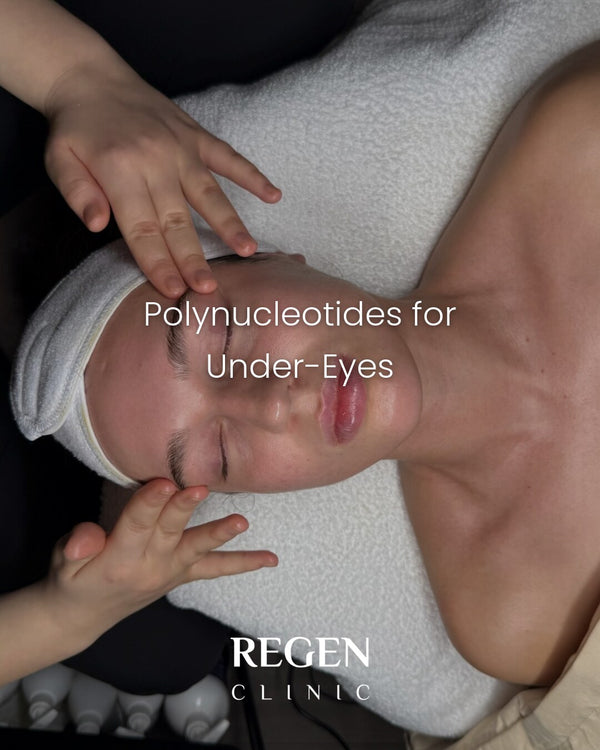
Polynucleotides are my choice when the problem is localised and the skin is thin. The under-eye is the clearest example, which is why it accounts for so much of the polynucleotide work we do. Fine perioral lines in skin too delicate for anything more aggressive. Skin that has been through previous procedures and needs rebuilding rather than stimulating. Atrophic, papery skin where adding volume would be the wrong instinct entirely.
Put simply, if I am thinking about repair in a small and delicate area, I am thinking about polynucleotides. If I am thinking about quality across a whole face, I am thinking about Profhilo.
When the answer is both, and the order that matters
For a good number of patients, both belong in the plan. They are complementary rather than competing, and treating them as an either-or decision is usually a false economy.
Where both are indicated, I sequence rather than stack. I would not treat the same area with both on the same day, and I would generally lead with whichever concern is dominant. If the whole face reads as tired and the under-eye is the worst part of it, I will usually establish the Profhilo course first and bring polynucleotides into the delicate area afterwards, spaced by a couple of weeks. If the under-eye is the only real complaint, there is no reason to treat the whole face to get there.
What I would resist is a plan built around having as much as possible. More regenerative treatment is not automatically better regenerative treatment, and the sequencing is a clinical decision, not a shopping preference.
The timing question people actually mean
When patients ask about timing they mean two things: how long until I look different, and how often will I be back.
Neither treatment is immediate, and anyone promising otherwise is overselling. Both work by changing how your skin behaves, which takes weeks rather than days. Profhilo is typically given as two sessions about four weeks apart, with maintenance thereafter at intervals agreed at review. Polynucleotides are usually given as a short course of around three sessions a fortnight or so apart, then maintained periodically. In both cases the exact protocol depends on the formulation used and on your skin, and results vary between individuals.
The practical implication is lead time. If there is an occasion in the diary, both of these need to be started months ahead, not weeks. It is one of the more common disappointments I have to manage, and it is entirely avoidable with a plan made early.
When neither is the right answer
Sometimes the honest answer is that a regenerative injectable is not what the skin needs yet.
If there is genuine volume loss, neither treatment will address it, and no amount of skin quality will substitute for structure. If the concern is pigmentation, that is a different pathway involving sun protection, the right topical regime and, sometimes, in-clinic pigment work. If the skin barrier is irritated, inflamed or actively flaring, we settle that first. Neither treatment is given in pregnancy or while breastfeeding. A genuine fish or salmon allergy is a specific consideration for polynucleotides, and anticoagulant medication, autoimmune conditions or a recent procedure in the area all need to be discussed at assessment rather than discovered on the day.
I would also want most patients on a sensible medical-grade routine before we inject anything. Regenerative treatment builds on prepared skin, and homecare compounds the result rather than competing with it.
How this fits the REGEN Method
Profhilo and polynucleotides both sit in the Generate pillar, alongside PRP and microneedling. They are the part of the plan where we ask the skin to rebuild. What determines which one you have, in what order, and whether you need both, is the assessment that comes first, and that standard is the same whether you see us in Norwich or at the London clinic. Homecare from the Elevate pillar sits underneath both, and the review appointments in Nurture are where the plan gets adjusted once we can see how your skin has actually responded.
Frequently asked questions
Can you have Profhilo and polynucleotides together?
Yes, and for many patients both belong in the same plan. I space them rather than treating the same area with both on the same day.
Which should come first?
Whichever concern is dominant. If the whole face has lost quality, Profhilo usually leads. If the issue is confined to the under-eye or another delicate area, polynucleotides are the more direct route and there is no need to treat the whole face first.
Which is better for under-eyes?
Polynucleotides, in most cases. The under-eye is thin skin needing repair, which is where they are strongest. Profhilo is not usually placed in the immediate under-eye area.
How long before I see a difference?
Both build gradually over the weeks following treatment rather than appearing immediately, and a course produces more than a single session. Individual response varies.
Which lasts longer?
Neither is permanent, and both are maintained periodically rather than repeated on a fixed schedule. Longevity depends on the protocol used, your skin, and how well the result is supported by homecare.
Can I have either while pregnant or breastfeeding?
No. We do not carry out either treatment in pregnancy or while breastfeeding.
Where to start
If you are weighing these two against each other, the decision is not one to make from a website, mine included. The assessment is what tells us whether your skin needs quality, repair, structure, or something that is not an injectable at all.
That assessment is the Reveal Consultation. The full clinical detail on each treatment sits on the Profhilo and polynucleotides pages.
— Dr Chris, Founder and Medical Director, REGEN Clinic
This article is general information, not personal medical advice. Suitability, protocol and expected outcome are determined at consultation, and individual results vary.
Read further, or actually do something about it.
If anything in this piece sounds like your skin, the next step is a Reveal Consultation. A 60-minute doctor-led skin assessment, a documented plan, and where appropriate the first treatment in the same visit.